
Acne fades. The scars it leaves behind often don’t — at least, not on their own. For many people, those marks on their skin are a daily reminder of something they’d rather forget. The frustrating part? No two patients scar the same way, and no single treatment fixes everything.
The good news is that 2026 is genuinely an exciting time to be treating acne scars. The combination of more precise laser technology, better understanding of skin biology, and smarter treatment sequencing means patients are seeing results that simply weren’t possible a decade ago.
This guide walks you through what causes acne scars, how to identify which type you have, and most importantly which treatments are actually delivering results right now.
Why Do Acne Scars Form?
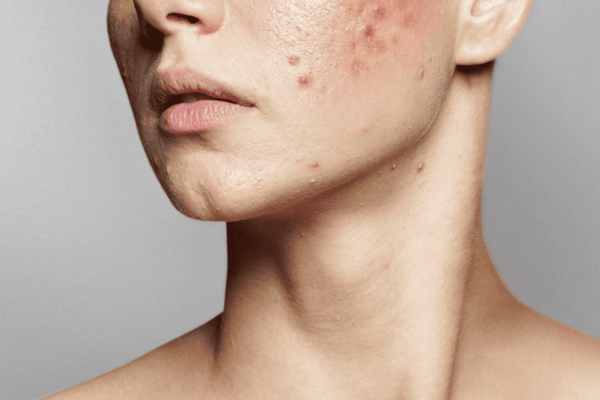
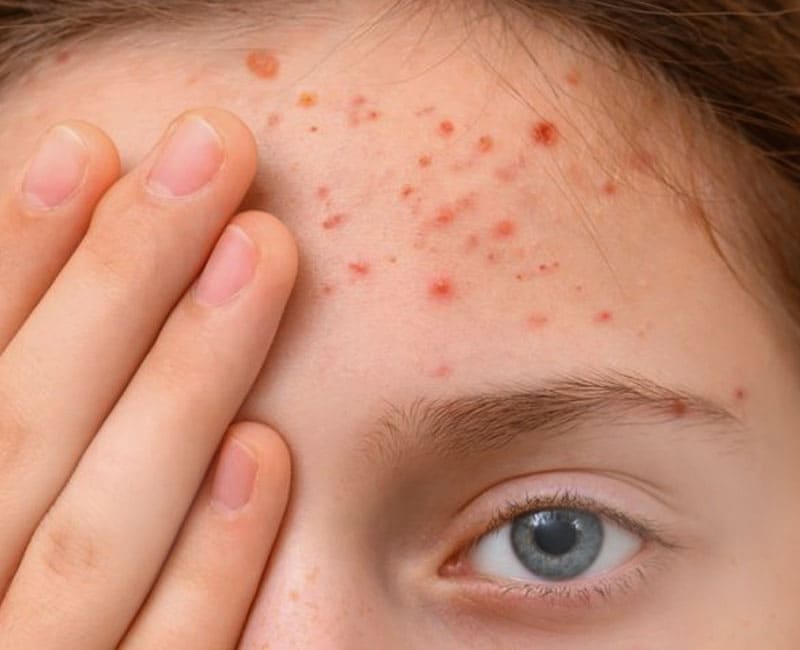
When acne penetrates deep into the skin and causes inflammation, it damages the surrounding tissue. As the skin tries to repair itself, it produces collagen. If it produces too little, the skin heals with an indentation. If it overproduces, you get a raised scar.
Not everyone who gets acne will scar — genetics plays a significant role. But certain behaviours dramatically increase your chances:
- Squeezing or picking at pimples (this is the big one)
- Leaving inflammatory acne untreated for too long
- Repeated breakouts in the same area
- Cystic or nodular acne, which affects deeper layers of skin
- A family history of scarring
The single most effective thing you can do to prevent scarring is treat active acne early and resist the urge to pick. Everything else comes after.
Types of Acne Scars
Before you can treat scars effectively, you need to know what you’re dealing with. The treatments that work well for one scar type often do very little for another.
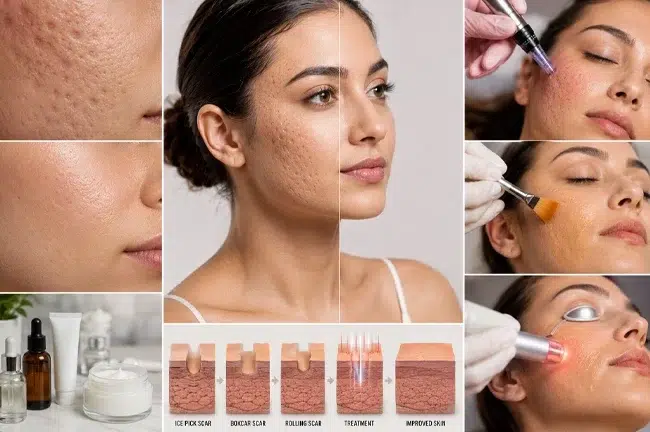
Depressed (Atrophic) Scars
These are by far the most common type and involve a loss of skin tissue.
Ice Pick Scars
Deep, narrow channels that go straight down into the skin like a puncture wound. Ice pick scars look small but extend surprisingly far, which makes them genuinely difficult to treat. Standard lasers and peels tend to have limited effect on their own.
Boxcar Scars
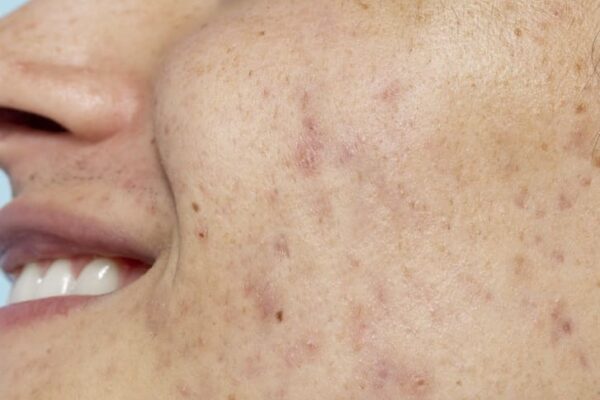
Wide, flat-bottomed depressions with sharply defined edges. They’re most common on the cheeks and temples and look similar to the kind of pitting you might see on an orange peel. They respond well to a range of treatments.
Rolling Scars
These create a wavy, undulating texture across the skin because fibrous tissue beneath the surface is pulling the skin downward. Rolling scars often look worse in certain lighting and can be mistaken for simply “rough” skin. Subcision (a specific procedure that cuts those fibrous bands) tends to work very well for these.
Raised (Hypertrophic) Scars
Less common with acne than atrophic scars, but they do occur — particularly on the chest, back, and jawline. These are firm, raised scars that result from the skin overproducing collagen during healing. They often improve on their own over time but can be stubborn.
Post-Inflammatory Hyperpigmentation (PIH)
Strictly speaking, PIH isn’t a scar — it’s a discolouration that lingers after acne heals. But it’s one of the most common reasons patients come in, and it’s often mistaken for actual scarring. It can take months to fade on its own, and sun exposure makes it significantly worse. The good news is that it responds very well to treatment.
Acne Scars Treatment – What Actually Works in 2026
There’s no shortage of treatments claiming to eliminate acne scars. Here’s an honest look at the ones with good clinical evidence behind them.
1.Fractional CO2 Laser Resurfacing
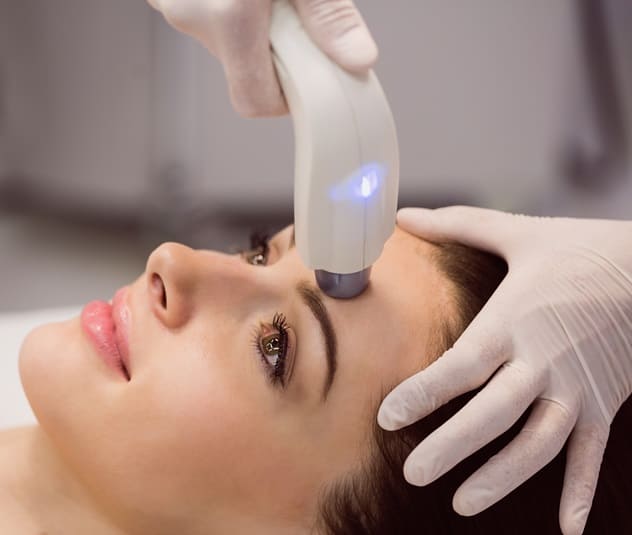
Still one of the most reliable treatments for moderate to severe acne scars, particularly boxcar and rolling types. Fractional CO2 Laser creates thousands of microscopic channels in the skin, triggering a wound-healing response that stimulates new collagen. The “fractional” aspect is key — it treats columns of tissue while leaving surrounding skin intact, which means faster healing than older ablative approaches.
Results are gradual (collagen takes months to build) but often dramatic. Most patients need three to five sessions. Expect some redness and downtime after each.
Best for: Boxcar and rolling scars, moderate to severe acne scarring, patients wanting significant improvement and willing to accept some downtime.
2. RF Microneedling
Radiofrequency microneedling has become one of the most popular scar treatments in the last few years — and for good reason. Tiny needles create controlled micro-injuries while simultaneously delivering radiofrequency energy into the dermis, stimulating collagen at a
deeper level than standard microneedling alone.
It works well across all skin tones, which matters — certain laser wavelengths carry a risk of post-inflammatory hyperpigmentation in darker skin types. Downtime is usually 2–3 days of redness and mild swelling.
Best for: Rolling and shallow boxcar scars, enlarged pores, patients with darker skin tones or limited downtime.
3. Subcision
For rolling scars specifically, subcision is one of the most underrated treatments available. A fine needle is inserted under the skin and moved in a fan-like motion to physically cut the fibrous bands tethering the scar tissue downward. Once released, the skin can spring back to a
more normal position.
Results are often visible almost immediately after swelling settles. Subcision is frequently combined with fillers or PRP to maximise the benefit. It’s a relatively simple procedure but requires a dermatologist with the right technique.
Best for: Rolling scars with tethering, deep depressed scars. Almost always used as part of a combination approach.
4. Chemical Peels
Chemical peels are not the heavy-hitters for deep scars, but they play a genuinely useful supporting role. Different formulations — salicylic acid, glycolic acid, TCA — penetrate at different depths and target different concerns. They’re particularly effective for post-inflammatory pigmentation and mild textural irregularities.
In a well-designed treatment plan, peels are often used between laser or microneedling sessions to maintain skin quality and manage pigmentation.
Best for: PIH, mild surface texture, acne-prone skin maintenance, prep between other treatments.
5. Dermal Fillers
Dermal Fillers aren’t the first thing people think of for acne scars, but for selected deep boxcar or rolling scars they can offer immediate, visible improvement. The filler material physically lifts the base of the scar to the level of the surrounding skin.
Results are temporary (typically 12–18 months depending on the product used), but fillers are often incorporated into comprehensive treatment plans where longer-term procedures are working in parallel.
Best for: Deep, isolated depressed scars where an immediate result is the goal.
6. PRP (Platelet-Rich Plasma)
PRP uses your own blood — specifically the concentrated growth factors extracted from it — to accelerate healing and collagen production. On its own, the evidence for PRP is modest. But as an add-on to laser or microneedling, it consistently seems to speed recovery and improve results.
It’s a natural approach with essentially no risk of reaction since it comes from your own body, which makes it a popular addition to most combination protocols.
Best for: Combination use with laser or microneedling. Particularly useful for patients who want to optimise healing.
7. Skin Boosters and Regenerative Treatments
One of the more genuinely interesting developments right now is the use of regenerative biologics like Exosomes, Growth factor serums, and advanced hyaluronic acid-based boosters that go beyond simple hydration to actively support skin remodelling.
We’re still in the early stages of understanding their full potential, but in combination with established treatments they appear to improve skin quality, hydration, and the overall environment in which scar remodelling happens.
Best for: Mild scars, skin quality improvement, supporting other active treatments.
Why Combination Treatment Is the Standard Now
If there’s one principle that defines modern acne scar treatment, it’s this: almost nobody achieves the best possible result from a single procedure.
Different scar types sit at different depths and respond to different mechanisms. A rolling scar held down by fibrous tissue needs subcision to release it — no amount of laser will cut those bands. A superficial pigmentation issue doesn’t need aggressive resurfacing; a well-chosen peel will do the job more safely.
A typical combination protocol might look like: subcision to release tethered scars, followed by a series of fractional CO2 sessions, with PRP added for recovery, and chemical peels between laser sessions to manage pigmentation. The exact sequence matters and varies based on each patient’s scar profile.
What’s New in 2026 for Acne Scar Treatment
A few developments are worth highlighting:
AI-Assisted Skin Analysis
Advanced imaging tools can now map scar depth, distribution, and type with much greater accuracy than clinical photography alone. This allows for more precise treatment planning and better tracking of progress over time.
Exosomes and Growth Factor Therapies
Exosomes — tiny vesicles that carry signalling molecules between cells — are showing real promise for enhancing collagen regeneration when used alongside conventional treatments. Still emerging, but the early data is encouraging.
Customised Laser Protocols
Modern laser platforms have become considerably more flexible. Spot size, depth, energy density and pulse duration can be adjusted much more precisely to match specific scar types and skin tones, reducing the one-size-fits-all approach that limited earlier technologies.
Reduced Downtime Protocols
There’s been genuine progress in treatment sequences that achieve meaningful results with shorter and less uncomfortable recovery periods — relevant for patients who can’t easily take time off.
How Many Sessions Will You Need?
This is always the first question, and the honest answer is: it depends. A rough guide:
- Mild scars: typically 3–4 sessions
- Moderate scars: usually 4–6 sessions
- Severe or deep scars: often 6–8 or more sessions
Improvement is gradual because the underlying mechanism — collagen remodelling — takes months. Most people continue to see results for 3–6 months after their final session. Managing expectations around this timeline is one of the most important conversations to have before starting treatment.
What to Realistically Expect
No treatment eliminates acne scars completely. Anyone who tells you otherwise is overpromising.
What modern treatment can realistically deliver is a significant improvement in appearance —typically 60–90% reduction in scar visibility for patients who complete a proper treatment course. For most people, the goal is scars that are no longer noticeable in normal light and no longer affecting confidence.
Some scar types (ice pick scars in particular) remain genuinely challenging even with the best available treatments. Being honest about this at the outset is part of good clinical practice.
Preventing Future Scars
Prevention is always easier than treatment. The essentials:
- Don’t pick — this is responsible for a disproportionate amount of scarring
- Treat active acne early and consistently
- Wear daily SPF (sun exposure worsens PIH significantly)
- Use a dermatologist-guided skincare routine during active acne
- See a dermatologist promptly if breakouts aren’t responding to over-the-counter products
Acne scars have historically been one of dermatology’s more frustrating challenges — visible, emotionally significant, and difficult to treat. The landscape has changed meaningfully.
The combination of better technology, a more sophisticated understanding of how different scar types respond to different interventions, and improved treatment sequencing means that patients today can achieve results that genuinely make a difference. The key is accurate diagnosis, a realistic treatment plan, and patience — collagen remodelling takes time, but the results tend to last.
If you’re ready to take the next step, the most useful thing you can do is book a consultation where your scars can be properly assessed. What works for someone else may not be what’s right for your skin — and a personalised plan will always outperform a generic one.
Worried about Acne Scars, Consult FMS Skin & Hair Clinics, Best Skin Clinic in Hyderabad for Advanced Cosmetic Skin Care Treatments done by expert Dematologists.
For Appointment Booking. Please call us or WhatsApp at 8885060760 Or Email Us at [email protected]